Home Home Home Contact Me About Me Facebook Twitter Teachers Pay Teachers Pinterest Bloglovin Email Me

Saturday, April 25, 2015

"Noise" In A Classroom - It's Not Always A Bad Thing!

When I first starting teaching (oh so many years ago!), I wanted a quiet classroom.  Almost to the level of hearing a pin drop.  Why?  Simple.  A quiet classroom, in my mind, was a sign of great classroom management.  It meant that my students were engaged, working and I was in control of the room.  I dreaded the question "can we work together" because working together leads to noise, noise leads to chaos and chaos lead to bad classroom management.  While I was right about chaos equaling bad management, I have learned that I was very wrong about the rest.  Noise and chaos are not the same thing.

A few years ago, as I got more comfortable as a teacher, as a part of the staff and with my subject matter I started relaxing a little and exploring other classroom structures.  I found that when a teacher structures it correctly and with strong expectations in place from the beginning, student collaboration can be one of the most powerful tools a teacher can use!  The key, I have found, is to start small at the beginning of a year or a term, before jumping into stations or collaborations that require a great deal of movement around the classroom.  I would describe the progression like this:

Step one:  Establish clear communication with your students about what your expectations are when they are talking to each other, participating in a classroom discussion or engaging in a group activity.  The clearer you are about what you expect, the easier it is to control the classroom and the students without requiring silence.  

Step two:  Start with small discussion pieces that are short and structured.  I will ask students to turn to their neighbor and complete an example problem together and then pick a random pair to come to the board to do it for the class.  This serves several purposes:

      ** It sets a time limit and destination (solving the problem), 
      ** It gives them clear direction for their talking
      ** It allows me to rotate and hear what they are talking about
      ** It gives me insight into whether they understand what we are doing (and I can correct it with questioning immediately)
      ** It involves all students since they don't know who will be called to go to the front board.


Partner Worksheet
Fold It Up
A great resource that I have found that helps to transition from this step to the next is made by Teaching High School Math called "Algebra Solving Equations Partner Worksheets".  In this activity students are paired up.  Each student works their problems individually, then they compare answers (which are the same even though they did different equations!) and talk through them if their answers don't match!  

I also really like a resource that I found by Live Love Math called "Fold It Up - Multistep Equations Practice"  It has students create a foldable and solve problems at the same time!  This is great for getting students talking and to break out of the mold of stand and deliver for note-taking.  

Step three:  Do an activity that requires small movement and group collaboration.  Task cards or investigation activities are fantastic for this!  I like using task cards because they can be used so many ways.  You can have the students pass the task cards from pair to pair or between small groups.  Additionally, you can set-up the task cards at stations and have groups of students rotate from station to station.  I also like investigation activities at this point because they require interaction, collaboration and hands-on learning but don't have to require students to be up and moving if your students aren't ready.

Congruent Triangles
Left, Right, Answer
I feature a few investigation activities in my TpT Store including Cut and Paste Activities.  One of my favorites is on Proving Triangles Congruent.  In it, students work in small groups to identify the method or methods being used to prove the triangles congruent and then cut them out and paste them under headings.  The discussion and collaboration that comes out of this is amazing.  I have included it in a money saving bundle that includes proof practice as well.

Task cards are fantastic!  I cannot say enough how much I love them!  They break concepts down into small tasks, help students to focus in on specific topics and encourage great collaboration.  One of my favorite ways to take task cards to the next level is made by 4mulafun called "Left, Right, Answer".  It turns using task cards into a game and more!  (You can check out a blog post about how to use them here.)

Step four:  This is usually the final step.  At this point your students are used to talking to each other and know what your expectations are when they do so.  They are (usually)  pretty good at keeping the noise level at a reasonable level and staying focused.  At this point you can really start having fun.  You can do activities that require large movement such as relay races, gallery walks where instead of tasks being at centers, they are posted on the walls and students are in almost constant movement. Getting to this point really is my favorite place.  I LOVE to see my students up, moving, interacting, collaborating and just generally getting to experience how much fun math can be.

Relay Race
I have seen so many products on TeachersPayTeachers that work here so well.   All Things Algebra has a fantastic relay race on Solving Systems of Equations.  This activity has students checking each others work and racing to get it done. I love it because the students have to not only be able to complete their part but also have to be able to look over the work of others to make sure it is correct!   Prizes could definitely be involved.  

Miss Math Dork has relay races where students do problems and draw a part of a figure.  One of my favorites covers the topic of Circumference and Area of Circles around a circus theme!  Which even team gets the circus scene drawn first, wins!  And as we all know, middle and high school students love competition and prizes! :)  She also has templates so that you can make your own!  

No matter what pace you take it at, collaboration and communication between not only teacher and student, but student to student as well is of critical importance.  I look back at those first few years and wonder why I thought I had to have a silent class to have control of it!  What do you do to encourage collaboration and communication?  What are some of your favorite activities?

Wednesday, April 8, 2015

The Secondary Mathletes!


A couple of months ago, I received a Facebook invite to join a group of dynamic, innovative, exceptional secondary math teachers who also happen to be sellers on TeachersPayTeachers.  These men and women are, in my mind, an amazing example of the daily balancing act that teachers perform.  They spend the day teaching with all their heart and energy, go home to their homes to do all of the daily things that need to be done and then create amazing resources to share with other teachers!  I have been truly blessed to be a part of this group.  I wanted to share this blessing with you as well and to introduce you to these awesome teacher-authors!

livelovemath

Live.Love.Math - Danielle Krantz
Grades 5 - 9
TpT Store
Blog
Facebook
lindsay perro
Lindsay Perro
Grades 6 - 9
TpT Store
Blog
Facebook
button
MissMathDork - Jamie Riggs
Grades 4 - Algebra I
TpT Store
Blog
Facebook
Nautical Blog Button
Lessons With Coffee - Jameson Ivey
Grades 5 - 8
TpT Store
Blog
Facebook
4mulaFun_Logo
4mulaFun - Jennifer Smith-Sloane
Grades 4 - 9
TpT Store
Blog
Facebook
gina
All Things Algebra - Gina Wilson
Grades 6 - 11
TpT Store
Blog
Facebook
secondary math workshop
Secondary Math Shop
Grades 8 - 12
TpT Store
Blog
Facebook
to the square inch
To the Square Inch - Kate Bing Coners
Grades 4 - 9
TpT Store
Blog
Facebook
 hart
Teaching Math By Hart
Grades 5 - 8
TpT Store
Blog
Facebook
teaching high school math
Teaching High School Math - Jennifer Lamb
Grades 6 - 12
TpT Store
Blog
Facebook
hodges
Hodges Herald - Elizabeth Hodges
Grades 5 - 8
TpT Store
Blog
Facebook
21st century
21st Century Math Projects - Clint Clark
Grades 6 - 12
TpT Store
Blog
scaffolded science and math
Scaffolded Math and Science - Shana Donohue
Grades 8 - 11
TpT Store
Blog
Facebook
for the love of teaching math
For the Love of Teaching Math - Andrea Kerr
Grades 6 - 12
TpT Store
Blog
Facebook
rundes room
Runde's Room - Jennifer Runde
TpT Store
Blog
Facebook
math station central
Math Stations Central - Adrienne Meldrum
TpT Store
While you are out looking at some new Mathletes in your grade level (and hopefully adding some great things to your wishlist), what are you looking for in resources? How can we help your further your teaching at the secondary level? We'd love to here from you HERE!

Saturday, March 21, 2015

Branching Out on Social Media

While I am not anti-technology, I usually prefer face to face contact (or at least voice-to-voice on the phone)!  That being said, I realize that I live in the year 2015 and that a social media presence is a necessary means by which to communicate.  The odd looks I get from my students when I ask what something is, lead me to do some research and get educated on social media!  So, I am pleased to announce that now you cannot only follow The Secondary Math Shop on Pinterest, but also on Twitter and Facebook!  I am getting ready to do my first give-away on Facebook when I hit 100 likes and 50 followers on Twitter.  I will announce the give-away on Facebook and on Twitter so keep your eyes peeled!

Tuesday, March 10, 2015

Writing In A Middle School Math Class, a Necessary Addition

I love math and writing and when I get the chance to combine the two, I am ecstatically happy!  What I am not always best at is coming up with the prompt for students to write about.  We have implemented in our math classes a writing tracker assignment twice weekly and an essay each semester.  Coming up with a topic once a week is hard enough, twice, well that made my brain hurt!  So I did what I always try to do when I am needing something - I turned to TpT.  I found the most amazing resource made by Live Love MathMiddle School Math Writing Prompts { Content Specific }.  This set includes 70 (seventy!!) writing problems that cover 5 major content standards and are perfect for middle school.  I have also used them for my ninth grade algebra class and found them amazing!  My students liked the fact that the questions are printed on a half-sheet of paper so that the question is right there and doesn't require them to keep looking up to remember the question.  I really enjoyed the fact that the questions could be done in a few minutes and that I had a variety to choose from!  I encourage you to check them out!

Sunday, March 8, 2015

More Effective Classroom Discussion and Questioning - How I'm Working to Make it Possible! (part one)

As a teacher you can find yourself in some very uncomfortable positions when standing in front of a classroom full of students, especially pre-teens or teenagers.  While you get pretty good at deflecting the inappropriate questions and comments and redirecting students who are heading off on a tangent, if you are anything like me, you still struggle with how to get responses out of students.  One of the most uncomfortable moments come when you ask a question and you get cricket eggs.  Not even crickets, just simply their eggs waiting to hatch.  It's that Ben Stein moment in Ferris Beuller...anyone, anyone, Beuller, Beuller...?   You ask, no one answers (or the same students who answers every question shouts something out), you ask again, still no response.  Then, nine times out of ten, you end up giving hints or just straight up answering your own question. 

In an attempt to combat this, I have spent this year on a quest (in that "free" time that we all don't have) to find more effective ways to facilitate classroom discussion.  I started by examining my own question techniques during a lesson to see if changing up HOW I am asking a question has any impact.  For example, I changed from asking "Does anyone have any questions" which gives students an out from asking any questions, to "What questions do you have" which assumes that there are questions that need to be answered.  This can prod students into thinking about whether they really get it or if there might be something that they are unsure about.  I have seen a rise in the amount of questions asked just by this simple change.

Taking into account that fact that many pre-teens and teens really like to "save face" in-front of their peers and not admit to not knowing something I have also expanded on this.   I will often ask  "If your friend wasn't here today, what question would they have tomorrow" or "Tell me one thing that your friend might be confused about if they just walked in and looked at the board".  Both of these questions allow students to have make it seem like it is someone else question and not their own.  Additionally, both encourage students to think outside of the box and look at a lesson or topic in a new light.  By asking students to put themselves in the brain of another person, they start to examine connections to prior knowledge and make those connections to new knowledge. 
The other major change I have made during classroom lessons and discussions is to put forth a concentrated effort to get students talking to each other and working with each other.  Once a student has answered one of my questions I will often not tell them if they are right or wrong (mean of me I know!).  Instead I will chose one a few different paths for follow. 

1)  I will ask someone else (or multiple someones) if they are agree or disagree with what the student said which serves multiple purposes. First,  it makes students really pay attention to the lesson and discussion since I call on random people not just those with their hands up.  Secondly, it makes them listen to each other since they can't explain if they agree or disagree if they don't know what the first student said.  Lastly, it helps students to focus their own thinking and understanding to figure out what they believe to be correct or not.

2)  I will ask someone to rephrase or expand upon what the student just said.  Rephrasing helps students to align their own understanding and to express it more coherently.  When I ask students to expand on what was just said, it takes the discussion to the next level and takes a simple answer to a rich mathematical inquiry.

3)  I will ask the student to convince me that they are correct.  Odd I know, but it makes students take ownership of their answer instead of just saying something for the sake of answering.  Additionally, when I go this route, I often find students pulling up prior knowledge, using better vocabulary and often asking if they can come to the board to show me.  Other students will chime in to help with the support needed or to correct misconceptions.  They love to be right and being given the opportunity to prove it is always a winner!


I don't have all of the answers, but I am seeing positive results so far so I'll keep at it and hopefully continue to improve!  Next step, improve discussion during group work and activities! :)

Thursday, March 5, 2015

Graphic Organizers: The What, Why and How of Implementation


Picture this:  You are a junior in high school with 6 classes a day, a part-time job, you have a boyfriend or girlfriend and you are vice-president of the student council.  Additionally, you have the demands of text messages going off on your phone every four minutes and you really need to sleep at some point.  You walk into your 1st hour math class and your teacher casually reminds you that you have a test, tomorrow, on an entire unit of material that was 9 sections long.  You have to work tonight and have a paper due for Government in two days!  Panicking yet?  I know that I would be!  


All hope is not lost, however, as your teacher starts handing out a set of graphic organizers that she made ahead of time.  These handy little sets of paper include flowcharts, tables, Venn Diagrams and other organizational tools designed to help you summarize the most important parts of the unit.  You are start to breath a (small) sigh of relief because at least now you have a place to start and maybe, just maybe, you can still work and study in order to pass the test!

For me, I wish graphic organizers has been used, publicized (as I'm sure they must have existed - we just never saw them) and/or encouraged as a study and organizational tool.  I had (and still at times have) issues retaining concepts for longer periods of time, partially because I was busy and partially because of how my brain worked.  Given that it was 20+ years ago when I was in high school and we didn't have the high stakes standardized testing pressures that students have today, I probably got off easy.


As a teacher at the secondary level, I see what my students have to deal with.  It goes beyond the scenario I outlined above to also include studying for the state testing, taking care of younger brothers and sisters, applying for colleges and scholarships and so much more.  As a result, I have spent time trying to find a way to help my students be able to better visualize that material, the connections between topics and to help them retain the knowledge beyond a unit test.  I want them to develop study skills that will aid them not only in finishing high school but to also help them succeed in college and the workforce.  I see graphic organizers as a way to do that for 4 reasons.


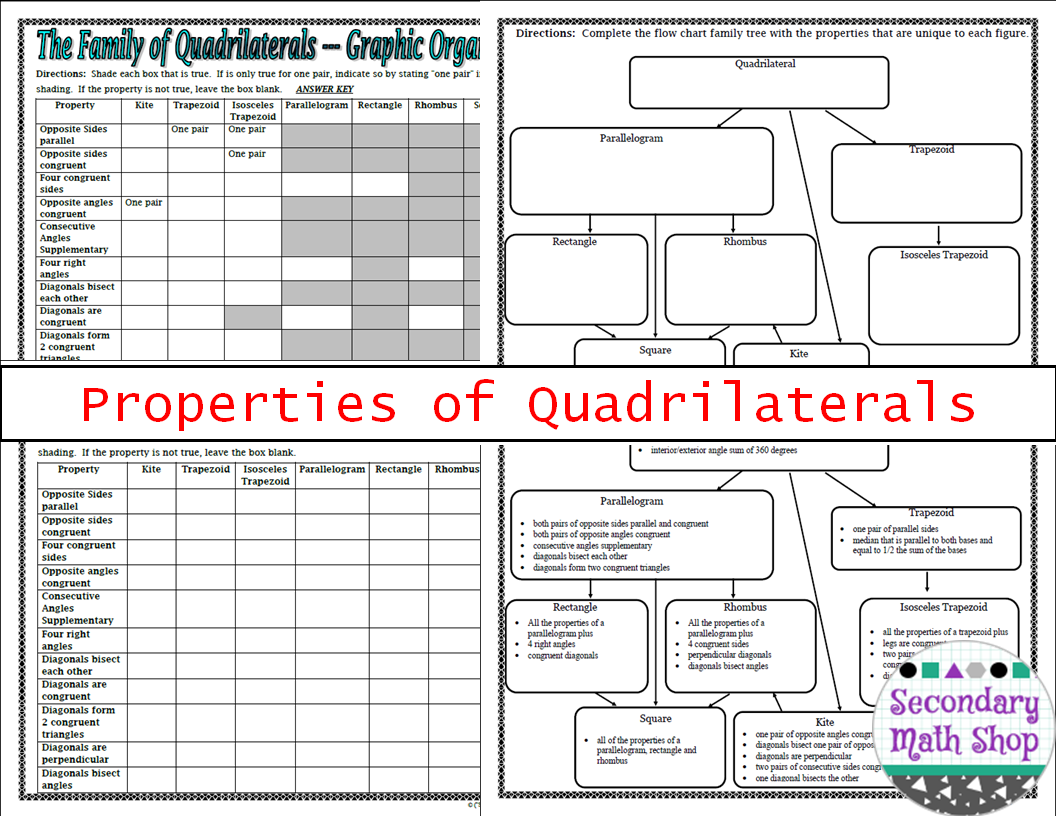
Quadrilaterals
1)  Graphic organizers are a visual way to "see" relationships.  In math so many topics are interrelated but sometimes the relationship can be difficult to see.  Through the use of bubbles, rectangles and arrows on a graphic organizer you can see how concepts effect each other.  For example, I teach that quadrilaterals form a family tree and teach it in flow chart format.  We create a graphic organizer together to show how the properties are "passed down" from one "generation" to the next.  My students really start to respond and "get it" once they can see how the quadrilaterals  are interrelated.


2)  Graphic organizers help students to organize the information in such a way as to highlight and summarize the important concepts.  As much as I would love to believe that every word that comes out of my mouth when I am teaching a lesson is pure gold, this is not true.  Realistically some of it is just filler, examples or ways of explaining a concept multiple ways to help students understand.  It is not always the meat of a topic but the sides dishes as well!  Graphic organizers help students to cut through the extra information to get to the foundational parts.  For example, when I teach my unit on Right Triangles and Trigonometry, I give my students a set of graphic organizers at the beginning of the unit that they can fill-in as we go along.  These organizers are designed for students to include all of the formulas and an example of solving or applying that formula since this is truly the crucial part of the unit.

3)  Graphic organizers appeal to visual learners.  In addition to helping most students see the relationships among topics, graphic organizers can help some students just simply see that information.  For some students, notes are just words on paper that they need to try to decode, often without success.  Graphic organizers can help them to make sense of those ideas and translate the information into a medium that speaks to them.  For example, when we do our unit on Circles, a unit that is extremely visual, my students who learn best visually are known to color coat the parts and constantly refer back to the organizers as they solve problems because they really help them to see, understand and be able to apply the concepts.


Circles
4)  Graphic organizers are a tool that students can use to hold on to information long term.  If students fill-out the graphic organizers as each unit progresses, then at the end of the semester, they have a great study tool to help them prepare for the final exam.  Instead of having to sort through notebooks full of notes or folders full of handouts, they have the most crucial information from the entire semester condensed down to a more manageable number of pages.  If the student is truly organized, and can really hold on to the papers long term, they can carry them through prepping for the state testing, entrance exams for college or even on their jobs.  

Whatever the reason or method, the course you teach or the level you teach at, I highly recommend implementing graphic organizers into your classes.  Not only will your students benefit, but you will too!  I have other graphic organizers than the ones listed, please click here to see them all!

Tuesday, March 3, 2015


Ever notice that the internet is flooded with elementary math ideas, but that finding quality secondary materials is virtually impossible.... LOOK NO FURTHER! I'd love to introduce you to the

Secondary Mathletes! mathlete image 9

livelovemath

Live.Love.Math - Danielle Krantz
Grades 5 - 9
TpT Store
Blog
Facebook
lindsay perro
Lindsay Perro
Grades 6 - 9
TpT Store
Blog
Facebook
button
MissMathDork - Jamie Riggs
Grades 4 - Algebra I
TpT Store
Blog
Facebook
Nautical Blog Button
Lessons With Coffee - Jameson Ivey
Grades 5 - 8
TpT Store
Blog
Facebook
4mulaFun_Logo
4mulaFun - Jennifer Smith-Sloane
Grades 4 - 9
TpT Store
Blog
Facebook
gina
All Things Algebra - Gina Wilson
Grades 6 - 11
TpT Store
Blog
Facebook
secondary math workshop
Secondary Math Shop
Grades 8 - 12
TpT Store
Blog
Facebook
to the square inch
To the Square Inch - Kate Bing Coners
Grades 4 - 9
TpT Store
Blog
Facebook
 hart
Teaching Math By Hart
Grades 5 - 8
TpT Store
Blog
Facebook
teaching high school math
Teaching High School Math - Jennifer Lamb
Grades 6 - 12
TpT Store
Blog
Facebook  
hodges  
Hodges Herald - Elizabeth Hodges
Grades 5 - 8
TpT Store
Blog
Facebook
21st century
21st Century Math Projects - Clint Clark
Grades 6 - 12
TpT Store
Blog
scaffolded science and math
Scaffolded Math and Science - Shana Donohue
Grades 8 - 11
TpT Store
Blog
Facebook
for the love of teaching math
For the Love of Teaching Math - Andrea Kerr
Grades 6 - 12
TpT Store
Blog
Facebook
rundes room
Runde's Room - Jennifer Runde
TpT Store
Blog
Facebook
math station central
Math Stations Central - Adrienne Meldrum
TpT Store  
While you are out looking at some new Mathletes in your grade level (and hopefully adding some great things to your wishlist), what are you looking for in resources? How can we help your further your teaching at the secondary level? We'd love to here from you HERE!
Related Posts Plugin for WordPress, Blogger...