Home Home Home Contact Me About Me Facebook Twitter Teachers Pay Teachers Pinterest Bloglovin Email Me
Showing posts with label visual geometry. Show all posts

Sunday, November 22, 2015

The Effect of Posting Word Walls and Vocabulary at the Secondary Level

I sat down and did a quick count of the "new" vocabulary that students encounter in Geometry.  If I discount the ones that students 'should' have heard before, I am still left with over 200 crucial terms, formulas and figures that students are expected to master by the end of a school year.  Yep, over 200...in addition to writing English papers, reading literature and history (and all the intricacies that it entails), science, electives and too many other things to list.  I don't know about you, but even just reading that list makes my brain hurt.  In an effort to help my students achieve mastery, I took it upon myself to create word walls of all of the major terms, figures and such.  


 First Semester Bundle
First Semester Bundle

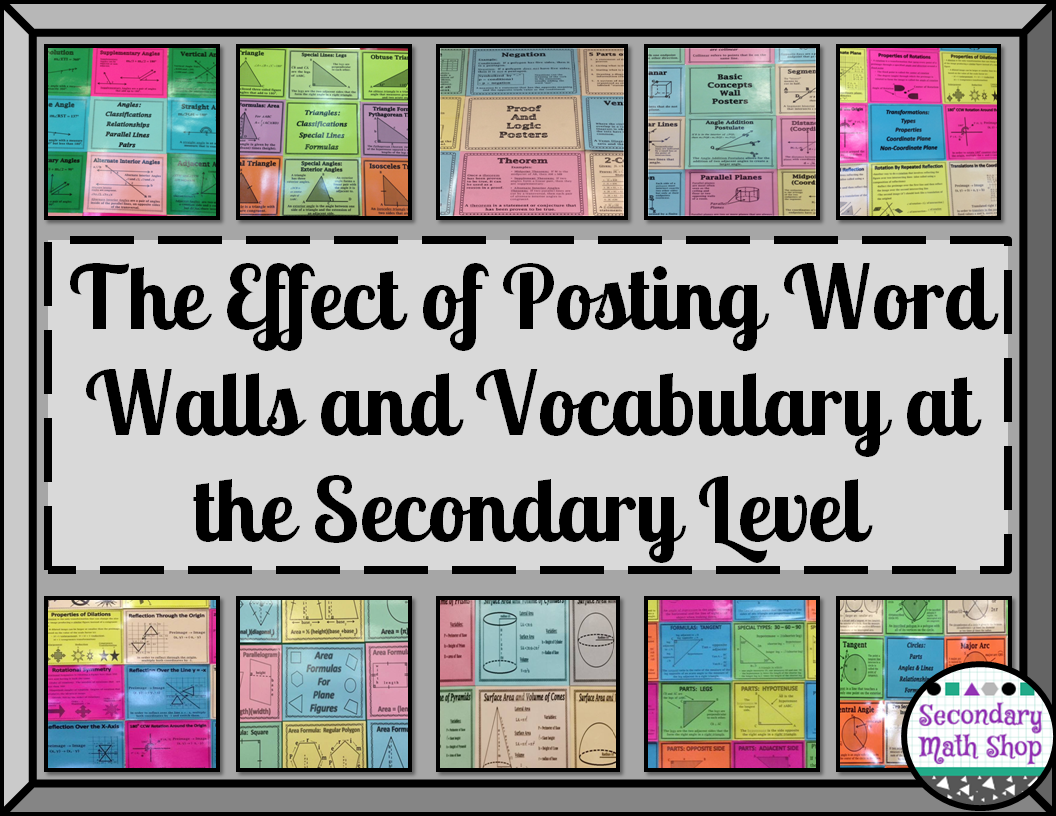
Each entry on my word walls includes the term, its definition, a diagram and/or example and other pertinent facts.  I broke my terms into semesters (first and second) and then further subdivided it into units.  I have found that keep them all up for the course of an entire semester has resulted in some fantastic results.

1)  My students refer back to the walls when they are stuck or don't remember something from a previous unit.  Their frustration level has decreased a great deal because they have a quick reference if they get stuck instead of having to flip through the book, their folders or other reference materials.

Second Semester Bundle
2)  Their ability to explain their thinking has increased dramatically because they have a better grasp of the vocabulary and how the concepts fit together.  For example, when we recently did our congruent triangle proofs, students were more successful because they were able to better remember facts about midpoints, bisectors and isosceles triangles - all of which are posted on the walls.

3)  Students are more focused on the concepts that we are studying because they can see how all the pieces are fitting together and they can see where we are headed.  I open the first week of school by telling the students that what is illustrated on my walls will be what we are studying.  We talk about what they already know and what impressions they have about what they are going to learn.

4)  My room just looks more put together and is a better reflection of high school.  Strange I know, but at the secondary level it is difficult to find decorations that are "older" instead of "elementary".

While it hasn't solved the entire problem of the horrendously long list of things that students today need to remember, it has helped and as teachers, that is one of the best things we can do...help!  


If you want to read more about word walls, my friend over at Scaffolded Math and Science shared their own experience with word walls in this blog post.  They also shared a link with me to their spectacular word wall for Algebra 2 available here.  The description includes "...references for domain, range, increasing and decreasing in interval notation, ... Also included is a quadratic example graph showing the vertex, the equation in vertex form (and how those two relate), domain, range, increasing and decreasing. ... how the x and y at the vertex can show up in domain (in the radical example) and range."


If you are looking for more of an Algebra 1 word wall then check out All Thing Algebra's "Relations & Linear Functions: Word Wall Cards + Template".  Not only does it include the terms "coordinate plane, quadrants, origin, ordered pair, relation, domain, range, mapping, discrete graph, continuous graph, function, function notation, vertical line test, zeros, slope, slope formula, zero slope, undefined slope, positive slope, negative slope, slope-intercept form, standard form, x- and y-intercepts, horizontal line, vertical line, parallel lines, and perpendicular lines" but it also includes a bonus template to create your own.  


If your needs fall into the middle level then check out Lindsay Perro's "Middle School Math Vocabulary Cards  "The product includes "120+ Common Core related vocabulary words. Each page includes three cards - one with the word, another with the definition and another with an example. Use together on a word wall or as a matching activity to help students learn the words that are critical to common core success in middle school! These cards would work great as a math center in your classroom! Included are both color and black and white versions. Also included are templates in PowerPoint so you can add your own words!"


To the Square Inch- Kate Bing Coners has taken the idea of math word walls one step further and not only offers them in English but in Spanish too!  Both sets feature "Common Core based word wall words with illustrations with super bright colored backgrounds."   The Spanish ones are "Perfect for bilingual classrooms, ELL classes, Spanish math classes or supporting your English Language Learners."  I encourage you to check them out!  I know I will be :) 


I would love to know how you use word wall cards.  Comment below and I'll chose one lucky commenter to receive their choice of one of my twelve sets of word wall posters!!!  

Thursday, March 5, 2015

Graphic Organizers: The What, Why and How of Implementation


Picture this:  You are a junior in high school with 6 classes a day, a part-time job, you have a boyfriend or girlfriend and you are vice-president of the student council.  Additionally, you have the demands of text messages going off on your phone every four minutes and you really need to sleep at some point.  You walk into your 1st hour math class and your teacher casually reminds you that you have a test, tomorrow, on an entire unit of material that was 9 sections long.  You have to work tonight and have a paper due for Government in two days!  Panicking yet?  I know that I would be!  


All hope is not lost, however, as your teacher starts handing out a set of graphic organizers that she made ahead of time.  These handy little sets of paper include flowcharts, tables, Venn Diagrams and other organizational tools designed to help you summarize the most important parts of the unit.  You are start to breath a (small) sigh of relief because at least now you have a place to start and maybe, just maybe, you can still work and study in order to pass the test!

For me, I wish graphic organizers has been used, publicized (as I'm sure they must have existed - we just never saw them) and/or encouraged as a study and organizational tool.  I had (and still at times have) issues retaining concepts for longer periods of time, partially because I was busy and partially because of how my brain worked.  Given that it was 20+ years ago when I was in high school and we didn't have the high stakes standardized testing pressures that students have today, I probably got off easy.


As a teacher at the secondary level, I see what my students have to deal with.  It goes beyond the scenario I outlined above to also include studying for the state testing, taking care of younger brothers and sisters, applying for colleges and scholarships and so much more.  As a result, I have spent time trying to find a way to help my students be able to better visualize that material, the connections between topics and to help them retain the knowledge beyond a unit test.  I want them to develop study skills that will aid them not only in finishing high school but to also help them succeed in college and the workforce.  I see graphic organizers as a way to do that for 4 reasons.


Quadrilaterals
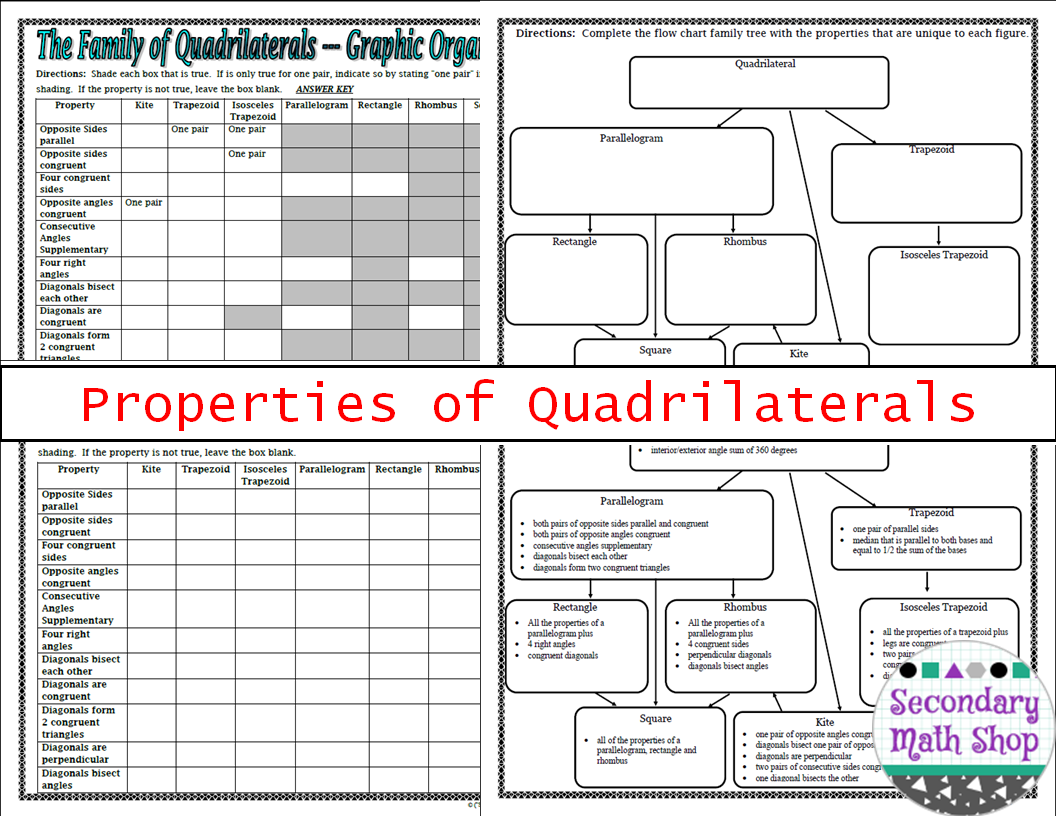
1)  Graphic organizers are a visual way to "see" relationships.  In math so many topics are interrelated but sometimes the relationship can be difficult to see.  Through the use of bubbles, rectangles and arrows on a graphic organizer you can see how concepts effect each other.  For example, I teach that quadrilaterals form a family tree and teach it in flow chart format.  We create a graphic organizer together to show how the properties are "passed down" from one "generation" to the next.  My students really start to respond and "get it" once they can see how the quadrilaterals  are interrelated.


2)  Graphic organizers help students to organize the information in such a way as to highlight and summarize the important concepts.  As much as I would love to believe that every word that comes out of my mouth when I am teaching a lesson is pure gold, this is not true.  Realistically some of it is just filler, examples or ways of explaining a concept multiple ways to help students understand.  It is not always the meat of a topic but the sides dishes as well!  Graphic organizers help students to cut through the extra information to get to the foundational parts.  For example, when I teach my unit on Right Triangles and Trigonometry, I give my students a set of graphic organizers at the beginning of the unit that they can fill-in as we go along.  These organizers are designed for students to include all of the formulas and an example of solving or applying that formula since this is truly the crucial part of the unit.

3)  Graphic organizers appeal to visual learners.  In addition to helping most students see the relationships among topics, graphic organizers can help some students just simply see that information.  For some students, notes are just words on paper that they need to try to decode, often without success.  Graphic organizers can help them to make sense of those ideas and translate the information into a medium that speaks to them.  For example, when we do our unit on Circles, a unit that is extremely visual, my students who learn best visually are known to color coat the parts and constantly refer back to the organizers as they solve problems because they really help them to see, understand and be able to apply the concepts.


Circles
4)  Graphic organizers are a tool that students can use to hold on to information long term.  If students fill-out the graphic organizers as each unit progresses, then at the end of the semester, they have a great study tool to help them prepare for the final exam.  Instead of having to sort through notebooks full of notes or folders full of handouts, they have the most crucial information from the entire semester condensed down to a more manageable number of pages.  If the student is truly organized, and can really hold on to the papers long term, they can carry them through prepping for the state testing, entrance exams for college or even on their jobs.  

Whatever the reason or method, the course you teach or the level you teach at, I highly recommend implementing graphic organizers into your classes.  Not only will your students benefit, but you will too!  I have other graphic organizers than the ones listed, please click here to see them all!

Saturday, January 31, 2015

Why I Do Vocabulary Assignments and Quizzes


During classroom discussions, my room used to sound a lot like this:


Me:  What do we know about these angles (points at a set of vertical angles)

Students: -----

Me:  What do these two angles share?

Student A:  A point

Me:  Great!  Where is that point located?

Student B:   Where they cross

Me:  What is that point called?

Students:  ------


The "discussion" would go on from there with me asking ever more information loaded questions trying to get the students to the point that the angles were vertical and therefore congruent.  It seriously made me doubt my teaching abilities.  Until the day that a light bulb went off in my head that is.  I realized that their lack of ability to answer my question had less to do with an understanding of the concepts and more to do with the fact that they lacked the language to express themselves mathematically.  I sat down that evening and made a list of all of the vocabulary that was new(er) to that unit.  Terms that they might have heard in passing or ones that I might have used, but not ones that they had ever really practiced.  I came up with almost 40.  I was astonished so I went back through the unit I was teaching and double-checked.  Nope, no mistake, it really was almost 40.  The next day I went into class and gave them five of them to define as bellwork.  The majority were able to give me two.  At that point I felt like I was in an old space movie - you know:  "Houston, we have a problem"...


As any good teacher does, however, I took the problem as a challenge to be tackled, addressed and fixed to benefit my students.  Out of this problem was born a simple solution - vocabulary assignments to launch each unit and periodic vocabulary quizzes through each unit.  


Vocabulary Bundle
Vocabulary Bundle
Each vocabulary assignment contained two parts.  The first part asks students define the term, draw a sketch (if possible) and to give any prior knowledge that they might have.  I stress to students to read the definition given in the glossary, the textbook or online and then to write it in their own words.  We talk about the fact that when they write it in their own words they will better understand it and retain it for future use.  For the prior knowledge portion we talk about maybe hearing it in a prior class, hearing it at home, seeing it in a book or other words a way may be used to help them start to make the connections.  I will admit, at first this is the column that they struggle with the most but as the year goes on, it gets filled in more and more.  The second part of the vocabulary assignment is a set of puzzles.  I include a crossword so that they read the definition and start to make connections to the term and a word search so that they learn to spell the vocabulary terms.  The students not only learn from doing these, but they also seem to enjoy them!  I have even had a few students ask if I could make them a specialized set!  (I have bundled an entire year of these assignments for Geometry here!)


The vocabulary quizzes that we do through the unit vary.  Sometimes they are matching with the definitions in one column and the terms in a second.  I also give them quizzes where there are paragraphs to fill-in with words from a word bank.  The hardest version, and the one that I tend to save until towards the end of the year, are the ones where I just give them the definition and they supply the word without being given a vocabulary list or word bank.  I find that as the year goes on, their scores on the quizzes get better and better.  


Games
Activities
In order to help  my students practice the vocabulary throughout a unit, I will utilize a variety of review and practice techniques.  I have made a few matching activities where the students cut apart pieces and match the term, definition, diagram and label.  I sometimes will do this in stations and just give the students an answer sheet.  Other times, I will literally have them cut and paste everything together.  I also have a created a few vocabulary based BINGO games that we use.  Additionally, we use Kahoot and Socrative to practice as well.  


Wall Posters
Finally, I have also created a set of posters for every unit that we study.  Each poster features a single vocabulary term, a diagram, the definition and any other crucial information or facts to support the definition.  I print the posters on card stock and laminate them so that I have them.  I post the vocabulary for the entire semester along one wall of my room.  It stays up until the new semester starts.  I find that students will take pictures of parts of the wall, especially if they are studying for a test or quiz.  And yes, I even leave them up during an assessment (although I will cover a specific unit during a vocabulary quiz).  By the time we get to an assessment the students know the vocabulary well enough and realistically, I am testing their application of the concepts by that point, not their memorization.

Friday, January 9, 2015

Quick Reference Sheets - A Perfect Fit for Interactive Notebooks and More!

Geometry (and math in general) is full of theorems, diagrams, formulas, calculations and so many more topic specific things to remember that students often suffer from brain overload.  Throughout my years of teaching math at the secondary level I have seen this happen on multiple occasions and when it happens, well the results are just not pretty.  The students begin to get frustrated trying to keep things straight, they act out or
Quick Ref
worse, they give up and shut down.  I am a big proponent of graphic organizers (coming soon in a future blog post!) but depending on the topic they can sometimes get lengthier than I would really like them to become.


Quick Ref
The need for something to help students really came to a head when we started talking about right triangle and trigonometry, specially the special right triangles formulas!  To overcome both the student shutting down and the length issues, I started thinking about how I remember things.  I mean, even though I'm a math teacher, I can't keep everything in my head at all times! :)  I realized that I often create "cheat sheets" for a lack of a better thing to call them.  These sheets usually consist of formulas, sketches and possibly shortcuts depending on what I'm trying to remember.  When I sat down to transfer my cheat sheets to something more students friendly, I ended up with something that was a cross between a graphic organizer and a formula list.

Each one ended up containing diagrams as well as the formulas that corresponded!  I decided that I didn't want to just give them everything thought.  I am a strong believer in the fact that when a student writes things down on their, they remember the information better.  As a result, I ended up creating two versions.

The first version has everything filled in as an answer key and as an accommodation for students with IEP's/504s.  This version also works great to leave at a station for an aide during a station review. 

Freebie!!!
Additionally, I have sent them home to parents to give them an overview of the unit that we are studying as well as putting them in my own unit plans.

The second version has blanks for students to fill in of the important information. 
I found that this works perfect for many things.  If they are printed two to a sheet, students can put them in an interactive notebook.  I have also used them as a review for a quiz or test and as a catch-up tool for absent students.

Bundle
So far I have created six:  Circles, Transformations, Area, Surface Area and Volume, Quadrilaterals and Right Triangles/Trigonometry.  This last one is my newest freebie in my TeachersPayTeachers store!  Please
check it out and let me know what you think. I have also bundle all six of my Quick Reference Sheets in a money-saving bundle!  I have more planned to cover other units of Geometry and eventually I might branch out and make some for algebra! 

Saturday, November 22, 2014

It's not a "sin" to do Trigonometry, It's a "Sine" of new content!

One of the biggest jokes in my class when I teach the Right Triangles and Trigonometry unit in my Geometry class is how to pronounce "sin".  I inevitable end up telling my students (jokingly of course) when they pronounce it as "sin" and not "sine" that it is not a sin to do Geometry.  Most of them giggle and then we discuss how to properly pronounce Geometric terms. 

One of the biggest problems I find in my Geometry class is a students inability to define the terms.  I cannot begin to count the number of times that I found it necessary in past years to redefine terms that we have already covered multiple times (think alternate interior angles versus consecutive interior angles).  Since vocabulary is so important in both general content and problem solving as well as on state testing I decided to talk the issue head on.

So in that spirit I want to share with you my top four ways to reinforce Geometrical vocabulary and to help students to retain it beyond a single unit.

Geometry B Bundle
Geometry A Bundle
1)  Illustrate, illustrate, illustrate!   I have embarked on a quest to illustrate our terms whenever possible.  I created sets of posters for every unit that we will study throughout the entire course.  Each poster is 8.5 by 11 and includes the definition, a labeled illustration and and pertinent facts.  I print them on card stock, laminate and hang them around the round grouped by unit.  I leave them up the entire trimester and refer to them constantly.  (I have them in my TeachersPayTeachers store in money saving bundles).


Triangles and Congruency
2)  Practice leads to retention!   I start every unit by asking my students to complete a vocabulary assignment (I usually give it to them as their assignment to complete after finishing the prior unit assessment).  Each vocabulary assignment includes a few pages where students give the definition, an illustration if necessary and any prior knowledge they might have.  I also include a crossword puzzle and a word search.  The students enjoy usually enjoy doing these assignments since it helps to give them a preview of what the unit will be covering. We refer back to these vocabulary lists as the unit goes on and students refine their definitions as the unit progresses. 


Congruency Vocabulary Activity
Early Concepts Bingo
3)  Play games or do activities!  Whenever possible I do vocabulary activities or play vocabulary games with my students.  I created some cut, paste and match activities for my students that require them to match the term, definition, a diagram and a label.  The students LOVE doing these.  It helps to tie all of the pieces together for them!  Additionally, we play vocabulary bingo games too.  I play one of two ways.  I either give them cards that are the terms or cards that are a diagram of the term.  Depending on what I gave them as a card, I will either read the term, read the definition or a project a diagram of the term.  We also play Kahoot (this does require you to have access to either I-Pads or smartphones and a projector or smart-board with internet access) which is the best online game to play I have seen in many years of teaching. 

4)  Get the students talking about the vocabulary and using it correctly!  I'm pretty sure that at times my students are either rolling their eyes when I'm not looking or thinking I'm slightly strange but I do not let them get away with skipping over the vocabulary during classroom discussions.  I ask them questions like "why can you do that" or "what geometry concept is being illustrated/applied" leading them back to the vocabulary all the time.  "Tell me why" is so commonly said in my classroom that after a couple of weeks I find students saying "wait, let me tell you why" or asking each other why!  I love it when it works!

Whatever works the best for you, embrace it!  The more you can get the students to understand the why, the what and the how behind what they are doing, the better they get at it!  In my opinion, students need to use mathematical vocabulary to truly retain the material. 


Wednesday, August 13, 2014

Embracing what you have in your classroom

My classroom is the typical one with cinder block walls, white/chalkboards, window, etc.  I have one exception though - I lack bulletin boards.  For whatever reason, when they put my room together they forgot to put up any bulletin boards.  After many years of trying to secure them, I have decided to embrace what I have instead of wishing for what I don't.

In that vein I have went on a quest to find something that would stick to whiteboard to dress it up without destroying the ability to write on it.  I knew that tape, ticky-tack and other adhesives would not do the trick, I needed something magnetic...and I found it!!!  I found magnetic whiteboard border!  It comes in packages of 12 strips that are 2 feet long each and runs about $10 a package.  A little pricey but since it won't rip, definitely worth it in my opinion.  While I found mine at a local teacher store (Lakeshore Learning) they do not sell borders online, so I did some research and you can purchase them on amazon as well.  Here is one link: Magna Borders


Mounting Tabs
With my "dressing up my whiteboards" problem solved, I turned my attention to how I can get anything to stay on my painted cinderblock walls.  I have all of these great Geometry posters that I have made but need a way to not have to rehang them every Monday morning. After trying it all - tacky-tape, duct tape, double sided tape, hot glue - I finally found something that not only works, but also doesn't hurt the posters and is completely removable!  They are called "Removable Mounting Tabs". They stick to the wall, they stick to the poster but do not harm either and remove easily.  Again I found them at the local teacher store (click on the picture to be taken to them online) for a reasonable price!

Sometimes teaching is about pushing for more, especially with our students and their learning potential, but sometimes it is about taking what you have and making it look amazing!  That is what I have chosen to do!  :)
Related Posts Plugin for WordPress, Blogger...