Home Home Home Contact Me About Me Facebook Twitter Teachers Pay Teachers Pinterest Bloglovin Email Me

Thursday, March 5, 2015

Graphic Organizers: The What, Why and How of Implementation


Picture this:  You are a junior in high school with 6 classes a day, a part-time job, you have a boyfriend or girlfriend and you are vice-president of the student council.  Additionally, you have the demands of text messages going off on your phone every four minutes and you really need to sleep at some point.  You walk into your 1st hour math class and your teacher casually reminds you that you have a test, tomorrow, on an entire unit of material that was 9 sections long.  You have to work tonight and have a paper due for Government in two days!  Panicking yet?  I know that I would be!  


All hope is not lost, however, as your teacher starts handing out a set of graphic organizers that she made ahead of time.  These handy little sets of paper include flowcharts, tables, Venn Diagrams and other organizational tools designed to help you summarize the most important parts of the unit.  You are start to breath a (small) sigh of relief because at least now you have a place to start and maybe, just maybe, you can still work and study in order to pass the test!

For me, I wish graphic organizers has been used, publicized (as I'm sure they must have existed - we just never saw them) and/or encouraged as a study and organizational tool.  I had (and still at times have) issues retaining concepts for longer periods of time, partially because I was busy and partially because of how my brain worked.  Given that it was 20+ years ago when I was in high school and we didn't have the high stakes standardized testing pressures that students have today, I probably got off easy.


As a teacher at the secondary level, I see what my students have to deal with.  It goes beyond the scenario I outlined above to also include studying for the state testing, taking care of younger brothers and sisters, applying for colleges and scholarships and so much more.  As a result, I have spent time trying to find a way to help my students be able to better visualize that material, the connections between topics and to help them retain the knowledge beyond a unit test.  I want them to develop study skills that will aid them not only in finishing high school but to also help them succeed in college and the workforce.  I see graphic organizers as a way to do that for 4 reasons.

Quadrilaterals
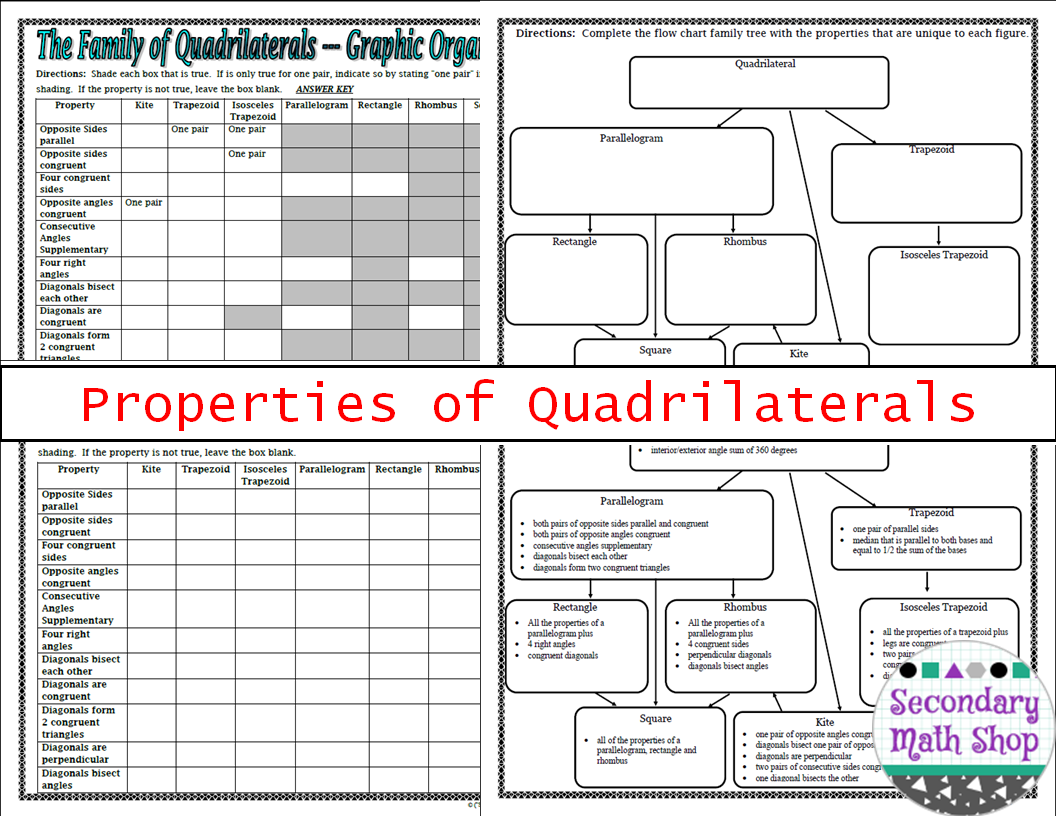
1)  Graphic organizers are a visual way to "see" relationships.  In math so many topics are interrelated but sometimes the relationship can be difficult to see.  Through the use of bubbles, rectangles and arrows on a graphic organizer you can see how concepts effect each other.  For example, I teach that quadrilaterals form a family tree and teach it in flow chart format.  We create a graphic organizer together to show how the properties are "passed down" from one "generation" to the next.  My students really start to respond and "get it" once they can see how the quadrilaterals  are interrelated.


2)  Graphic organizers help students to organize the information in such a way as to highlight and summarize the important concepts.  As much as I would love to believe that every word that comes out of my mouth when I am teaching a lesson is pure gold, this is not true.  Realistically some of it is just filler, examples or ways of explaining a concept multiple ways to help students understand.  It is not always the meat of a topic but the sides dishes as well!  Graphic organizers help students to cut through the extra information to get to the foundational parts.  For example, when I teach my unit on Right Triangles and Trigonometry, I give my students a set of graphic organizers at the beginning of the unit that they can fill-in as we go along.  These organizers are designed for students to include all of the formulas and an example of solving or applying that formula since this is truly the crucial part of the unit.

3)  Graphic organizers appeal to visual learners.  In addition to helping most students see the relationships among topics, graphic organizers can help some students just simply see that information.  For some students, notes are just words on paper that they need to try to decode, often without success.  Graphic organizers can help them to make sense of those ideas and translate the information into a medium that speaks to them.  For example, when we do our unit on Circles, a unit that is extremely visual, my students who learn best visually are known to color coat the parts and constantly refer back to the organizers as they solve problems because they really help them to see, understand and be able to apply the concepts.


Circles
4)  Graphic organizers are a tool that students can use to hold on to information long term.  If students fill-out the graphic organizers as each unit progresses, then at the end of the semester, they have a great study tool to help them prepare for the final exam.  Instead of having to sort through notebooks full of notes or folders full of handouts, they have the most crucial information from the entire semester condensed down to a more manageable number of pages.  If the student is truly organized, and can really hold on to the papers long term, they can carry them through prepping for the state testing, entrance exams for college or even on their jobs.  

Whatever the reason or method, the course you teach or the level you teach at, I highly recommend implementing graphic organizers into your classes.  Not only will your students benefit, but you will too!  I have other graphic organizers than the ones listed, please click here to see them all!

Tuesday, March 3, 2015


Ever notice that the internet is flooded with elementary math ideas, but that finding quality secondary materials is virtually impossible.... LOOK NO FURTHER! I'd love to introduce you to the

Secondary Mathletes! mathlete image 9

livelovemath

Live.Love.Math - Danielle Krantz
Grades 5 - 9
TpT Store
Blog
Facebook
lindsay perro
Lindsay Perro
Grades 6 - 9
TpT Store
Blog
Facebook
button
MissMathDork - Jamie Riggs
Grades 4 - Algebra I
TpT Store
Blog
Facebook
Nautical Blog Button
Lessons With Coffee - Jameson Ivey
Grades 5 - 8
TpT Store
Blog
Facebook
4mulaFun_Logo
4mulaFun - Jennifer Smith-Sloane
Grades 4 - 9
TpT Store
Blog
Facebook
gina
All Things Algebra - Gina Wilson
Grades 6 - 11
TpT Store
Blog
Facebook
secondary math workshop
Secondary Math Shop
Grades 8 - 12
TpT Store
Blog
Facebook
to the square inch
To the Square Inch - Kate Bing Coners
Grades 4 - 9
TpT Store
Blog
Facebook
 hart
Teaching Math By Hart
Grades 5 - 8
TpT Store
Blog
Facebook
teaching high school math
Teaching High School Math - Jennifer Lamb
Grades 6 - 12
TpT Store
Blog
Facebook  
hodges  
Hodges Herald - Elizabeth Hodges
Grades 5 - 8
TpT Store
Blog
Facebook
21st century
21st Century Math Projects - Clint Clark
Grades 6 - 12
TpT Store
Blog
scaffolded science and math
Scaffolded Math and Science - Shana Donohue
Grades 8 - 11
TpT Store
Blog
Facebook
for the love of teaching math
For the Love of Teaching Math - Andrea Kerr
Grades 6 - 12
TpT Store
Blog
Facebook
rundes room
Runde's Room - Jennifer Runde
TpT Store
Blog
Facebook
math station central
Math Stations Central - Adrienne Meldrum
TpT Store  
While you are out looking at some new Mathletes in your grade level (and hopefully adding some great things to your wishlist), what are you looking for in resources? How can we help your further your teaching at the secondary level? We'd love to here from you HERE!

Wednesday, February 25, 2015

Teachers are Heroes Sale Extended!!!!

I am excited to announce that the TpT Teachers are Heroes Sale has been extended for second day!!! Be sure to stock up, save and Use The Code - HEROES are check to save an extra 10% on top of what stores are offering!  A total savings of up to 28%.  My entire store - Money Saving Bundles - included is one sale for 20% off!  So visit TpT.com and the Secondary Math Shop to stock up and save!

Tuesday, February 24, 2015

Geometry Bellwork - A Longtime Project, FINALLY Finished!

I am happy, relieved, exhaustively excited to announce that I have finished the last set of bellwork for Geometry!  It is a combination unit on Similarity, Special Lines and Triangle Inequalities.  I combined the three together because a) none of them are really long enough to stand on their own and b) I teach them all as one unit! 

Additionally, I am pleased to tell you that I have bundled my bellwork into a first semester MONEY SAVING bundle and a second semester MONEY SAVING bundle as well as an entire year bundle!  Each unit in each bundle includes a full - color powerpoint, a teacher answer key, each day double printed so that you can hand them out as exit cards if you wish and a weekly student answer sheet! 

1st Semester
2nd Semester
Entire Year


I love using bellwork (bellringers or do-nows as my students call them) because not only does it help to settle a class, but it is also a great way to review previous concepts, assess where students are having difficulty and to get students up to the board!  You can read more about my love of bellwork here

Sunday, February 22, 2015

Algebra Skills in the Geometry Classroom


There was a time when Geometry was seen as the stand alone class in the math family tree.  When I was in high school, you could take Geometry in 10th grade or 11th, before or after Algebra II.  Basically you took it where ever and whenever it best fit in to your schedule.  Geometry at time was all about shapes, angles and proofs.  There was little to no Algebra used and the little that you did need, you could sort of fake it.  Not anymore.  Now Geometry is Algebra based.  With the advent of constantly changing standards and continually changing standardized testing each  math class is now a continuation of the previous one, often relying heavily on mastery of the previous one to be successful in the next.

When I start a new school year in Geometry I spend the first day or two reviewing how to set-up and solve linear equations.  Why you may ask?  Simple.  Every new concept that we do from solving for parts of segments and angles all the way through surface area and volume, can and will, involve finding the value of a missing variable.  This is done more often than not through a linear equation, usually in one variable to the first power.  In regards to solving equations, we even use them as the basis for our proof structure.  When I begin to introduce how to write a proof, I don't start with Geometric proofs, I start with Algebraic.  I ask my students to solve multi-step linear equations and to tell me what they did in each step.  This not only gets them used to the structure, but also reinforces why they do what they do when solving a linear equation.

As we move further on into the school year even more concepts from Algebra begin to pop up.  One of the most prevalent is the use of the Cartesian Coordinate Plane.  We first encounter it when we are finding the length (distance) of a segment.  We graph the two endpoints and use the Distance and Midpoint formulas to find how long the segment is and where the halfway point is.  Since this is more of a review, then a new concept however, I teach it using Task Cards for the students to practice versus spending a day on it like it is a new lesson.  We continue using the coordinate plane and Algebraic Concepts when we graph triangles and quadrilaterals and use the distance, midpoint and slope formulas to classify our shapes.  The last time that we explicitly use the coordinate plane is in our unit on Transformations when we graph our figures and reflect, translate, rotate and dilate them using coordinates.  

The other major Algebraic concept that use consistently is square roots and radicals.  We first encounter them when we solve the distance formula but at point it is a pretty basic use.  Once, however, we hit our unit on Right Triangles and Trigonometry, squares roots stick with us for the rest of the school year.  We use them to solve our right triangles and to find missing pieces of quadrilaterals.  We also use them when finding the tangent, radii and diameter lines for circles and the surface area and volume of three dimensional figures.  
For these reasons, and so many more, I stress mastery of concepts, not just retention of them for a test in my Algebra class.  I am honest with my students and I tell them that this ideas will not "go away" once Algebra is done.  They will use them again in Algebra II and then will take Algebra I and II skills with them as they move into Geometry.  Additionally, we talk extensively about which of these skills will be useful in the workforce and why.  I try to be as transparent as possible with my students and normally it works in my favor.  What Algebra skills have you seen move beyond Algebra?

Monday, February 9, 2015

Can't Live Without Secondary Math E-Book

The second installment of the Secondary Teacher Collaboration books are here and they look fantastic!  Lindsay Perro has done an amazing job of compiling one - page informational insights into the sellers and one page freebies from over 20 secondary math sellers!  Each informational page tells you a little about the seller, some of their favorite resources and things that they cannot live without!  Each one page freebie is ready to print and use!  You can download the math book here:
Math

I have added my freebie from the book to my store and I have included an answer key as well!  You can download it here:

SMS Freebie!


If you are looking for resources for other topics, there are also books on Science, ELA and the Humanities!  Be sure to check them out!  Happy teaching!


Thursday, February 5, 2015

Writing Equations of Lines Stations Maze - From Mrs. E. Teaches Math

Teaching Algebra is not always in my comfort zone.  After so many years of teaching Geometry, where my students have completed two years of Algebra before getting to me, I am used to reviewing and/or just applying the topics - not actually teaching them from scratch.  Over the past few years I have gotten better, but I still don't feel as creative as I would like.  In particular, my students are really struggle with writing the equations of lines from different sources.  I am struggle to make it more interesting and engaging.  Enter TpT and all of the wonderful resources on there!  Mrs. E gave me a copy of her Writing Equations of Lines Station Maze to try with them and it went fantastically!


This activity was a great way to not only get the students up and moving, but also was great for getting the students to talk to each other!  I am very big on math talk in the classroom and cooperative learning.  I started by posting the nine stations around the room in random order.  I paired off the students as they came in instead of letting them chose their own partners.  I liked that I was able to give each pair of students a different starting point since the cards do not have to be done in order.  This helped with congestion and also allowed me to keep students apart that are a little too talkative.

I also loved the fact that when the students found an answer it sent them to a different station but if they got sent backwards to someplace they had already been, they knew they need to go back and check their previous work to see where they got off track.  In this way, it really was a maze!  I also liked the fact that there were four possible answers and if they got something was not on the card, then they knew they needed to recheck their work.  In multiple ways this activity was really self-checking.

I encourage you to visit Mrs. E Teaches Math and pick up a copy for yourself.  Not only will your students be engaged, but you will be able to identify common misconceptions quickly!


Related Posts Plugin for WordPress, Blogger...